

(English) Preserving community history: A digital archive of consumer/survivor businesses in southwestern Ontario, 1980-2005
My doctoral research is a historical institutional ethnographic study, looking at the period from 1980 to 2005, when consumer/survivor businesses were first established, secured funding from the Ontario Ministry of Health through the Consumer Survivor Development Initiative (CSDI), and established themselves in communities across southwestern Ontario. Some businesses, such as the Out of this World Café, even set up shop within the psychiatric hospital, taking over the canteen at CAMH’s Queen Street site in 2002 (OCAB 2004) and later expanding to run a cafeteria on-site in 2013.
While conducting this research, the uptake I received from community members, people involved in establishing these businesses, and the businesses themselves far exceeded my initial expectations. All told I spoke with 42 participants, who were incredibly generous in terms of entrusting me with the material history of these businesses, which has not yet been properly documented in any formal archives. As such, I have acquired a wide range of hard copy materials, including photographs, business plans, policy documents, films and faxes from participants’ personal collections. Viewed collectively, these materials tell a story of advocacy, acts big and small, by consumer/survivors and the important role these businesses played as sites of community organizing.
As an extension of this work, I am digitizing these materials with participant consent. In partnership with Madness Canada, we will be building a digital archive to preserve this history and make it publicly accessible. I am grateful to be a recipient of the Hewton and Griffin Funding Award, as it makes building this digital archive possible and will help bring this local history to light.
As an extension of this work, I am digitizing these materials with participant consent. In partnership with Madness Canada, we will be building a digital archive to preserve this history and make it publicly accessible. I am grateful to be a recipient of the Hewton and Griffin Funding Award, as it makes building this digital archive possible and will help bring this local history to light.
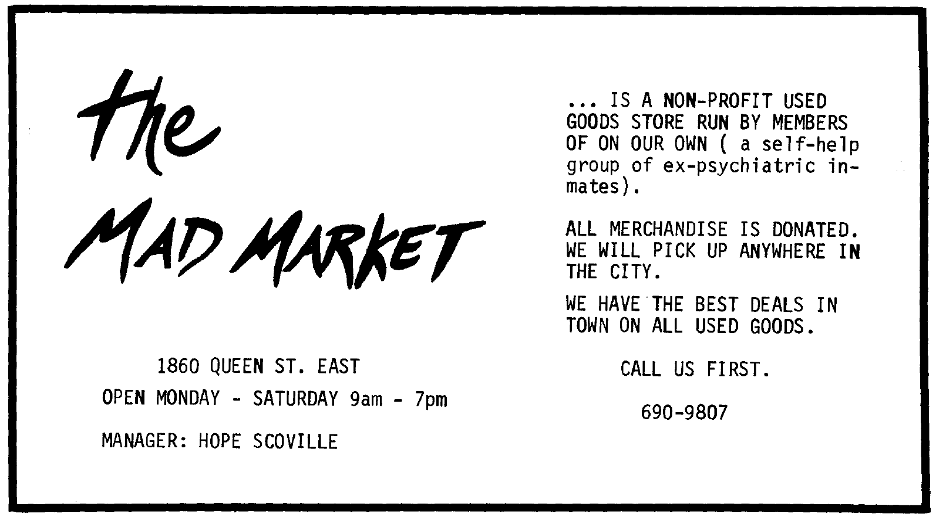
Caption: An ad for the Mad Market (the first consumer/survivor business in Ontario), published in Phoenix Rising magazine’s winter 1983 issue.
As an extension of this work, I am digitizing these materials with participant consent. In partnership with Madness Canada, we will be building a digital archive to preserve this history and make it publicly accessible. I am grateful to be a recipient of the Hewton and Griffin Funding Award, as it makes building this digital archive possible and will help bring this local history to light.
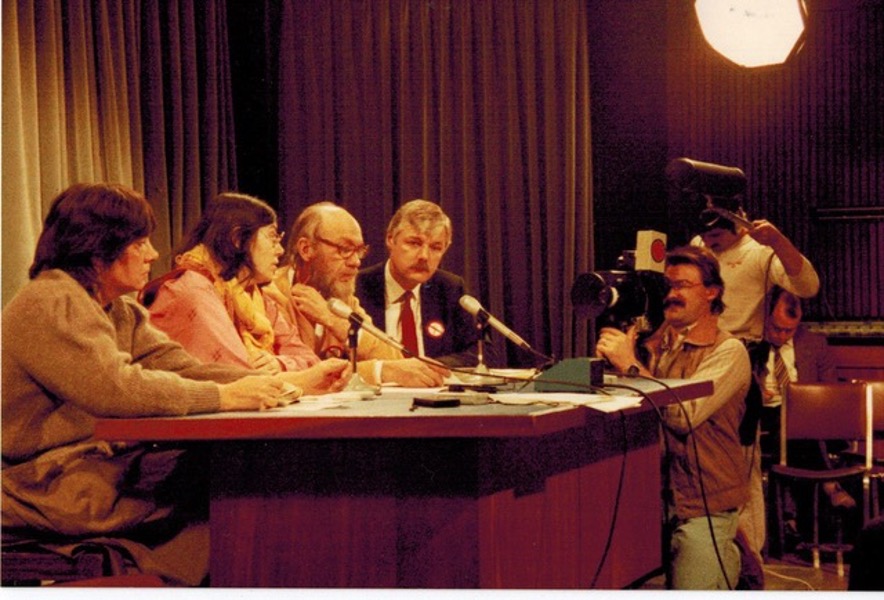
Photo of a press conference on electroconvulsive therapy (ECT) held in the Queens Park Media Room, dated January 9, 1986. From left to right: Carol Stubbs (then manager of the Mad Market), Dr. Bonnie Burstow, Don Weitz, and David Reville (then Ontario MPP for Riverdale). Photo provided by David Reville.
As I sort through scraps of newspaper, photographs and faxes – some of the material history research participants have kind-heartedly shared with me – I am struck by how much advocacy work and knowledge sharing took place within consumer/survivor businesses, particularly in the 1990s. If you’re not familiar with that term, it refers to social enterprises (also known as ‘alternative businesses’) started and run primarily by people with mental health histories. Looking at these materials, I’m struck by how these small businesses – everything from cleaning companies, woodworking shops, landscapers and more – became sites of so much health-related advocacy in Ontario. And yet, most people remain unaware of this local activist history.
My doctoral research is a historical institutional ethnographic study, looking at the period from 1980 to 2005, when consumer/survivor businesses were first established, secured funding from the Ontario Ministry of Health through the Consumer Survivor Development Initiative (CSDI), and established themselves in communities across southwestern Ontario. Some businesses, such as the Out of this World Café, even set up shop within the psychiatric hospital, taking over the canteen at CAMH’s Queen Street site in 2002 (OCAB 2004) and later expanding to run a cafeteria on-site in 2013.
While conducting this research, the uptake I received from community members, people involved in establishing these businesses, and the businesses themselves far exceeded my initial expectations. All told I spoke with 42 participants, who were incredibly generous in terms of entrusting me with the material history of these businesses, which has not yet been properly documented in any formal archives. As such, I have acquired a wide range of hard copy materials, including photographs, business plans, policy documents, films and faxes from participants’ personal collections. Viewed collectively, these materials tell a story of advocacy, acts big and small, by consumer/survivors and the important role these businesses played as sites of community organizing.
Caption: An ad for the Mad Market (the first consumer/survivor business in Ontario), published in Phoenix Rising magazine’s winter 1983 issue.
As an extension of this work, I am digitizing these materials with participant consent. In partnership with Madness Canada, we will be building a digital archive to preserve this history and make it publicly accessible. I am grateful to be a recipient of the Hewton and Griffin Funding Award, as it makes building this digital archive possible and will help bring this local history to light.
Caption: Photo of a press conference on electroconvulsive therapy (ECT) held in the Queens Park Media Room, dated January 9, 1986. From left to right: Carol Stubbs (then manager of the Mad Market), Dr. Bonnie Burstow, Don Weitz, and David Reville (then Ontario MPP for Riverdale). Photo provided by David Reville.
As I sort through scraps of newspaper, photographs and faxes – some of the material history research participants have kind-heartedly shared with me – I am struck by how much advocacy work and knowledge sharing took place within consumer/survivor businesses, particularly in the 1990s. If you’re not familiar with that term, it refers to social enterprises (also known as ‘alternative businesses’) started and run primarily by people with mental health histories. Looking at these materials, I’m struck by how these small businesses – everything from cleaning companies, woodworking shops, landscapers and more – became sites of so much health-related advocacy in Ontario. And yet, most people remain unaware of this local activist history.
My doctoral research is a historical institutional ethnographic study, looking at the period from 1980 to 2005, when consumer/survivor businesses were first established, secured funding from the Ontario Ministry of Health through the Consumer Survivor Development Initiative (CSDI), and established themselves in communities across southwestern Ontario. Some businesses, such as the Out of this World Café, even set up shop within the psychiatric hospital, taking over the canteen at CAMH’s Queen Street site in 2002 (OCAB 2004) and later expanding to run a cafeteria on-site in 2013.
While conducting this research, the uptake I received from community members, people involved in establishing these businesses, and the businesses themselves far exceeded my initial expectations. All told I spoke with 42 participants, who were incredibly generous in terms of entrusting me with the material history of these businesses, which has not yet been properly documented in any formal archives. As such, I have acquired a wide range of hard copy materials, including photographs, business plans, policy documents, films and faxes from participants’ personal collections. Viewed collectively, these materials tell a story of advocacy, acts big and small, by consumer/survivors and the important role these businesses played as sites of community organizing.
Caption: An ad for the Mad Market (the first consumer/survivor business in Ontario), published in Phoenix Rising magazine’s winter 1983 issue.
As an extension of this work, I am digitizing these materials with participant consent. In partnership with Madness Canada, we will be building a digital archive to preserve this history and make it publicly accessible. I am grateful to be a recipient of the Hewton and Griffin Funding Award, as it makes building this digital archive possible and will help bring this local history to light.