This diaspora played a key role in transforming psychiatry by integrating Meyer’s ideas and procedures into medical curricula, general hospitals, and outpatient services. Through clinical reforms, and extensive involvement in mental hygiene committees as well as psychiatric programs in government, law, and the military, Meyerian ideas normalized psychiatry both medically and culturally, and the specialty garnered a newfound medical and social authority. By investigating the circulation of Meyer’s ideas through his trainees, my research explains how these processes established contemporary institutional and educational frameworks in psychiatry and influenced modern cultural attitudes towards mental illness and mental health. While the Meyerian diaspora was global, my project contributes to the historiography of Canadian psychiatry by demonstrating that Meyer and his trainees shaped psychiatric reform across Canada. At the Alan Mason Chesney Medical Archives at Johns Hopkins, I found that Meyer corresponded with approximately nearly 100 people in Canada, the Dean of the University of Toronto Faculty of Medicine and leader in Canadian psychiatry, C. K. Clarke; the founder of the Canadian National Committee for Mental Hygiene (CNCMH), Clarence Hincks; editor-in-chief of the American Journal of Psychiatry and the first head of the University of Toronto’s Department of Psychiatry, Clarence Farrar; American Psychiatric Association President, George H. Stevenson; prominent psychoanalyst and Freud biographer Ernest Jones; and the renowned Canadian psychologist, Edward Bott; as well as organizations such as the CNCMH and the Canadian Psychiatric Association. Additionally, Meyer’s influence extended into other medical and psychiatric institutions, including Canadian medical schools and psychiatric facilities from Nova Scotia to British Columbia.
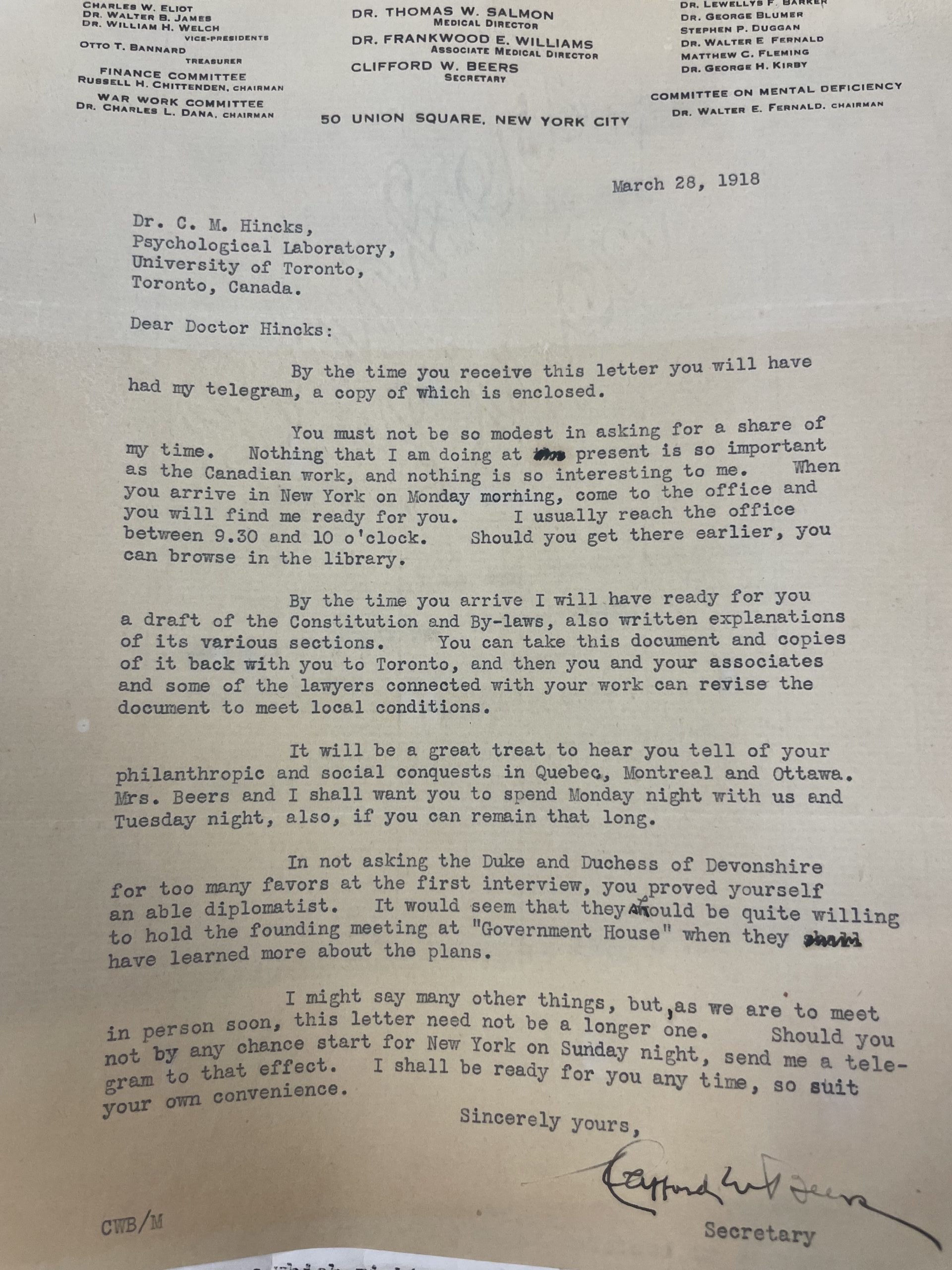
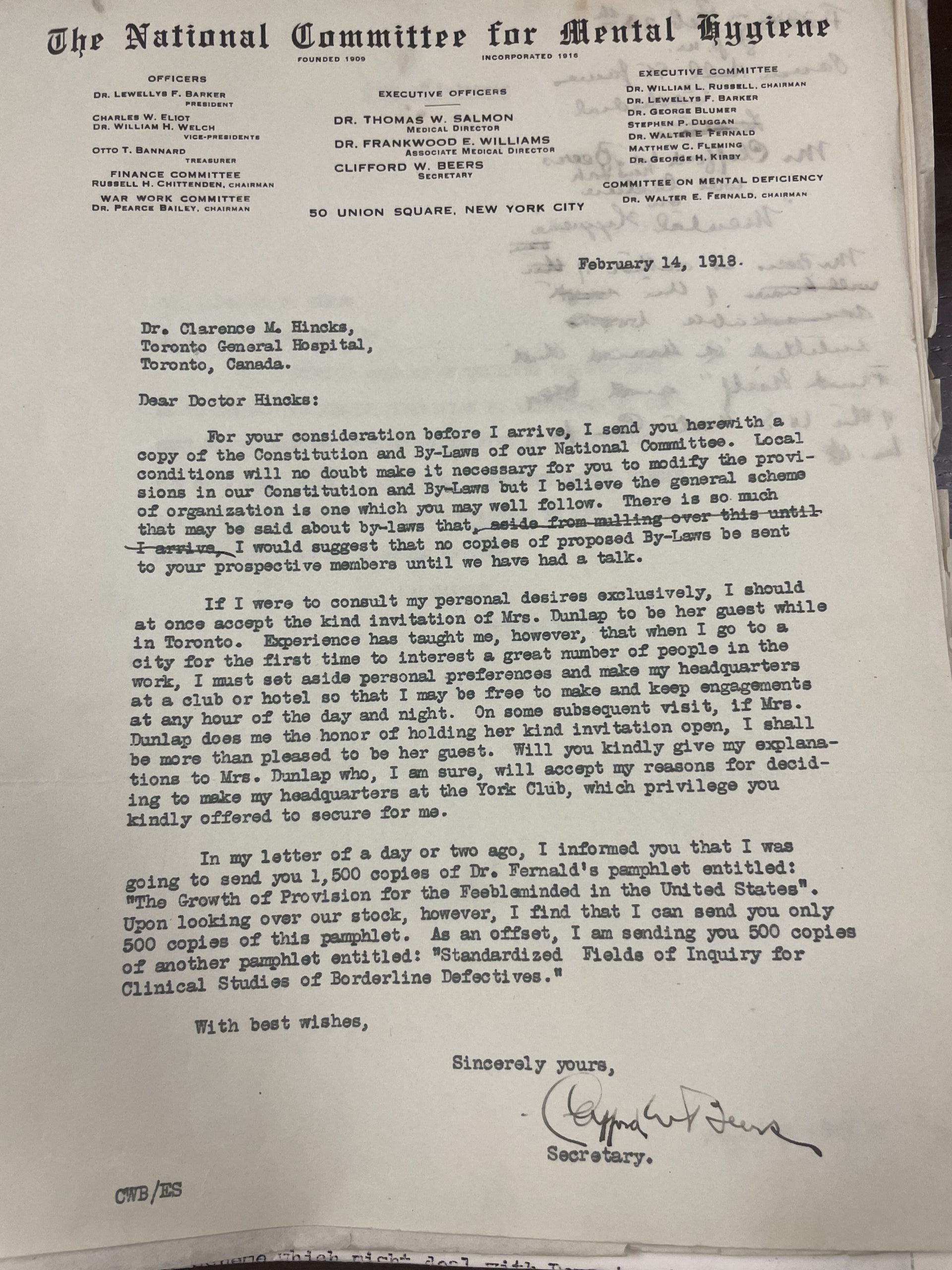
In Canada, the CAMH archives are the best place to conduct this research. Through the generous funding provided by the Hewton-Griffin Archival Research Funding Award, I was able to visit the CAMH archives in November 2024, and my findings are helping to identify how psychiatric reform has evolved in this country. For instance, the archive contains documents produced by Meyer’s colleagues and students, such as Farrar, Alexander Leighton, Paul Lemkau, and R. O. Jones. These materials indicate that Meyer’s reform ideas permeated Canadian institutions through his trainees. Additional resources at CAMH, like the CNCMH Scientific Planning Committee reports, Toronto General Hospital Psychiatric Clinic files, and the correspondences of Clarence M. Hincks, who headed both the CNCMH and its American counterpart, the National Committee of Mental Hygiene, also offer critical insights into the evolution of psychiatric reform in Canada. One notable discovery I made at the CAMH Archives is a series of letters between Clarence Hincks, the Chief Medical Officer of the Canadian Federal Government at the time, Peter Bryce, and Clifford Beers, the co-founder of the NCMH along with Meyer. These letters reveal that Beers sent the Constitution and By-Laws of the NCMH with the intent to ensure that other national committees followed the American model which was designed by Meyer. Beers also recognized that the establishment of the Canadian committee marked the birth of the international mental hygiene movement. These findings underscore Meyer’s influence on Canadian psychiatry given his crucial role in the NCMH and his naming and shaping of the committee’s goals.
Meyer’s correspondence further illustrates his direct influence on Canadian psychiatric practices. His Canadian colleagues frequently sought his advice on institutional reforms, hospital designs, nurse training, curriculum development, and mental hygiene initiatives. These exchanges suggest that Meyer and his reform program had a widespread impact on both the professional practices of psychiatrists and the institutional structures of psychiatry in Canada. I hope that further analysis of the documents at the CAMH archives will help me to determine the extent and nature of the Meyerian reform program and its influence in Canada. By analyzing these archival materials, my research provides a historiographically, culturally, and clinically significant understanding of Meyer’s contributions to psychiatry. This approach offers critical insights into the transnational dissemination of Meyerian reforms, their adaptation within Canada, and their role in crafting the modern psychiatric landscape. Ultimately, my study will advance historical knowledge of psychiatry’s evolution in Canada, demonstrating how Meyer’s ideas shaped the specialty as we know it today.
Clifford W. Beers to Clarence M. Hincks, 14 February 1918
CAMH Archives, Canadian Mental Health Association fonds, F13 Clarence Meredith Hincks Papers, Box H4, No. 1 (Correspondence — Hincks and Beers, Jan–Feb 1918 — Founding Canadian Mental Hygiene Committee, p. 7).
Caption: Clifford W. Beers to Clarence M. Hincks, 14 February 1918. Ahead of his first visit to Toronto, Beers sends Hincks the constitution and by-laws of the National Committee for Mental Hygiene as a model for a Canadian committee. CAMH Archives, F13, Box H4, No. 1.
Transcription conventions: original spelling, punctuation and capitalisation retained; struck-through text shows deletions on the original; underlining reproduces underlining on the original; editorial notes appear in italics within square brackets.
[Letterhead: The National Committee for Mental Hygiene. Founded 1909. Incorporated 1916. 50 Union Square, New York City. Officers: Dr. Lewellys F. Barker, President; Charles W. Eliot, Dr. William H. Welch, Vice-Presidents; Otto T. Bannard, Treasurer. Finance Committee: Russell H. Chittenden, Chairman. War Work Committee: Dr. Pearce Bailey, Chairman. Executive Officers: Dr. Thomas W. Salmon, Medical Director; Dr. Frankwood E. Williams, Associate Medical Director; Clifford W. Beers, Secretary. Executive Committee: Dr. William L. Russell, Chairman; Dr. Lewellys F. Barker; Dr. George Blumer; Stephen P. Duggan; Dr. Walter E. Fernald; Matthew C. Fleming; Dr. George H. Kirby. Committee on Mental Deficiency: Dr. Walter E. Fernald, Chairman.]
February 14, 1918.
Dr. Clarence M. Hincks,
Toronto General Hospital,
Toronto, Canada.
Dear Doctor Hincks:
For your consideration before I arrive, I send you herewith a copy of the Constitution and By-Laws of our National Committee. Local conditions will no doubt make it necessary for you to modify the provisions in our Constitution and By-Laws but I believe the general scheme of organization is one which you may well follow. There is so much that may be said about by-laws that, aside from mulling over this until I arrive, I would suggest that no copies of proposed By-Laws be sent to your prospective members until we have had a talk.
If I were to consult my personal desires exclusively, I should at once accept the kind invitation of Mrs. Dunlap to be her guest while in Toronto. Experience has taught me, however, that when I go to a city for the first time to interest a great number of people in the work, I must set aside personal preferences and make my headquarters at a club or hotel so that I may be free to make and keep engagements at any hour of the day and night. On some subsequent visit, if Mrs. Dunlap does me the honor of holding her kind invitation open, I shall be more than pleased to be her guest. Will you kindly give my explanations to Mrs. Dunlap who, I am sure, will accept my reasons for deciding to make my headquarters at the York Club, which privilege you kindly offered to secure for me.
In my letter of a day or two ago, I informed you that I was going to send you 1,500 copies of Dr. Fernald’s pamphlet entitled: “The Growth of Provision for the Feebleminded in the United States”. Upon looking over our stock, however, I find that I can send you only 500 copies of this pamphlet. As an offset, I am sending you 500 copies of another pamphlet entitled: “Standardized Fields of Inquiry for Clinical Studies of Borderline Defectives.”
With best wishes,
Sincerely yours,
[signed] Clifford W. Beers
Secretary.
CWB/ES
Transcriber’s notes
The deletion in paragraph 1 is struck through in ink on the original; it is unclear whether the comma after “that” falls inside the deletion.
Faint handwriting at the upper right of the page is bleed-through or offset from an adjacent sheet and is not part of this letter.
Clifford W. Beers to Clarence M. Hincks, 28 March 1918
CAMH Archives, Canadian Mental Health Association fonds, F13 Clarence Meredith Hincks Papers, Box H4, No. 1 (Correspondence — Hincks and Beers, Mar 1918 — Speaking Tour and Organizing Meetings, p. 9).
Caption: Clifford W. Beers to Clarence M. Hincks, 28 March 1918. Beers invites Hincks to New York to collect a draft constitution for the Canadian committee, and anticipates holding its founding meeting at Government House. CAMH Archives, F13, Box H4, No. 1.
Transcription conventions: original spelling, punctuation and capitalisation retained; struck-through text shows deletions on the original; underlining reproduces underlining on the original; editorial notes appear in italics within square brackets.
[Letterhead of the National Committee for Mental Hygiene, 50 Union Square, New York City; cropped at the top of the image and not transcribed.]
March 28, 1918
Dr. C. M. Hincks,
Psychological Laboratory,
University of Toronto,
Toronto, Canada.
Dear Doctor Hincks:
By the time you receive this letter you will have had my telegram, a copy of which is enclosed.
You must not be so modest in asking for a share of my time. Nothing that I am doing at [one word typed over and obliterated] present is so important as the Canadian work, and nothing is so interesting to me. When you arrive in New York on Monday morning, come to the office and you will find me ready for you. I usually reach the office between 9.30 and 10 o’clock. Should you get there earlier, you can browse in the library.
By the time you arrive I will have ready for you a draft of the Constitution and By-laws, also written explanations of its various sections. You can take this document and copies of it back with you to Toronto, and then you and your associates and some of the lawyers connected with your work can revise the document to meet local conditions.
It will be a great treat to hear you tell of your philanthropic and social conquests in Quebec, Montreal and Ottawa. Mrs. Beers and I shall want you to spend Monday night with us and Tuesday night, also, if you can remain that long.
In not asking the Duke and Duchess of Devonshire for too many favors at the first interview, you proved yourself an able diplomatist. It would seem that they would [overtyped; “should” may be the underlying word] be quite willing to hold the founding meeting at “Government House” when they [one word, possibly “shall,” typed over and obliterated]have learned more about the plans.
I might say many other things, but, as we are to meet in person soon, this letter need not be a longer one. Should you not by any chance start for New York on Sunday night, send me a telegram to that effect. I shall be ready for you any time, so suit your own convenience.
Sincerely yours,
[signed] Clifford W. Beers
Secretary
CWB/M
Clifford W. Beers to Peter H. Bryce, 7 May 1918
CAMH Archives, Canadian Mental Health Association fonds, F13 Clarence Meredith Hincks Papers, Box H4, No. 1 (Letter — Beers to Bryce, May 7 1918 — Constitution and By-Laws for CNMH). Copy forwarded to Hincks with Beers’s handwritten note.
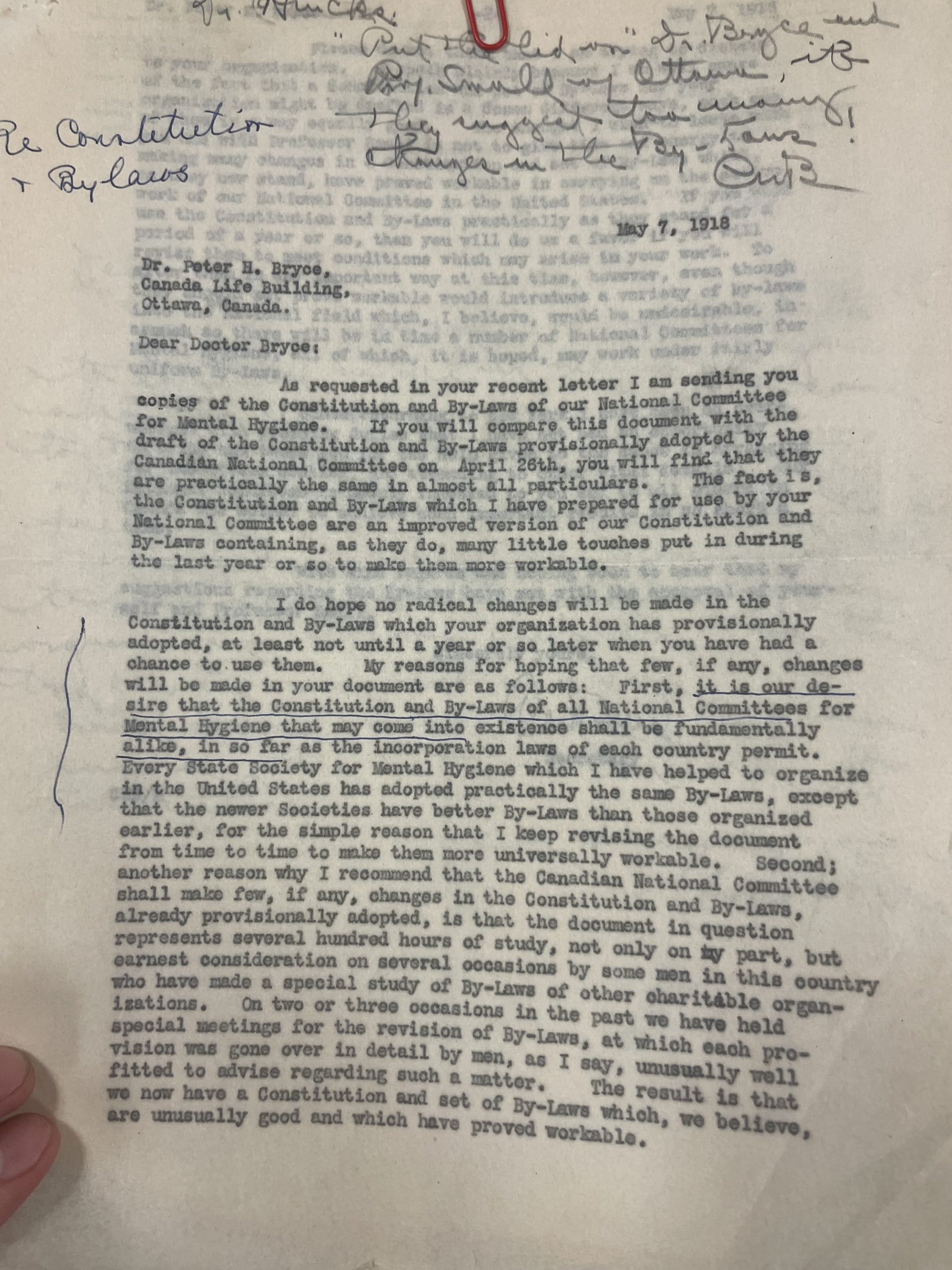
Caption: Clifford W. Beers to Peter H. Bryce, 7 May 1918, copy annotated for Clarence M. Hincks. Beers urges the new Canadian National Committee for Mental Hygiene to keep its provisional by-laws largely unchanged, so that national committees remain “fundamentally alike.” His note tells Hincks to “put the lid on” Bryce and Professor Small if they propose too many changes. CAMH Archives, F13, Box H4, No. 1.
Transcription conventions: original spelling, punctuation and capitalisation retained; struck-through text shows deletions on the original; underlining reproduces underlining on the original; editorial notes appear in italics within square brackets.
[Handwritten, top of page 1, in Beers’s hand:]
Dr. Hincks:
“Put the lid on” Dr. Bryce and
Prof. Small of Ottawa, if
they suggest too many!
changes in the By-Laws.
CWB
[Handwritten, left margin of page 1, in a different hand:] Re Constitution & By-laws
May 7, 1918
Dr. Peter H. Bryce,
Canada Life Building,
Ottawa, Canada.
Dear Doctor Bryce:
As requested in your recent letter I am sending you copies of the Constitution and By-Laws of our National Committee for Mental Hygiene. If you will compare this document with the draft of the Constitution and By-Laws provisionally adopted by the Canadian National Committee on April 26th, you will find that they are practically the same in almost all particulars. The fact is, the Constitution and By-Laws which I have prepared for use by your National Committee are an improved version of our Constitution and By-Laws containing, as they do, many little touches put in during the last year or so to make them more workable.
[Vertical pen line in left margin alongside this paragraph.] I do hope no radical changes will be made in the Constitution and By-Laws which your organization has provisionally adopted, at least not until a year or so later when you have had a chance to use them. My reasons for hoping that few, if any, changes will be made in your document are as follows: First, it is our desire that the Constitution and By-Laws of all National Committees for Mental Hygiene that may come into existence shall be fundamentally alike, in so far as the incorporation laws of each country permit. Every State Society for Mental Hygiene which I have helped to organize in the United States has adopted practically the same By-Laws, except that the newer Societies have better By-Laws than those organized earlier, for the simple reason that I keep revising the document from time to time to make them more universally workable. Second; another reason why I recommend that the Canadian National Committee shall make few, if any, changes in the Constitution and By-Laws, already provisionally adopted, is that the document in question represents several hundred hours of study, not only on my part, but earnest consideration on several occasions by some men in this country who have made a special study of By-Laws of other charitable organisations. On two or three occasions in the past we have held special meetings for the revision of By-Laws, at which each provision was gone over in detail by men, as I say, unusually well fitted to advise regarding such a matter. The result is that we now have a Constitution and set of By-Laws which, we believe, are unusually good and which have proved workable.
[Page 2, headed:] May 7, 1918
Please do not think that I am trying to dictate to your organization. I speak plainly because I am well aware of the fact that a Constitution and set of By-Laws for your organization might be drafted in a dozen different ways, each one of them in a way equally good. The thought I wish to leave with you and with Professor Small is not to give time and energy to making many changes in a Constitution and set of By-Laws which, as they now stand, have proved workable in carrying on the active work of our National Committee in the United States. If you will use the Constitution and By-Laws practically as they stand for a period of a year or so, then you will do us a favor if you will revise them to meet conditions which may arise in your work. To alter them in any important way at this time, however, even though they should notprove workable would introduce a variety of By-laws into the National field which, I believe, would be undesirable, inasmuch as there will be in time a number of National Committees for Mental Hygiene, all of which, it is hoped, may work under fairly uniform By-Laws.
Since returning to New York I have been so overwhelmed with pressing duties that I have not had an opportunity to write and thank you for the help given to the cause in arranging for the Ottawa meeting, and attending to other vital details. Our National Committee is deeply indebted to you and to all others in Canada who helped to achieve such important results in so short a time.
With kind regards and hoping soon to hear that my suggestions regarding the By-Laws have met with the approval of yourself and Professor Small,
Sincerely yours,
[signed] C W Beers
Secretary
CWB/M
Transcriber’s notes
The underlining and the marginal line in paragraph 2 are in ink; they are not assigned to a hand.
In Beers’s note, the “!” after “many” is the transcriber’s best reading, and “if” could be read as “it.”
“Organisations” is spelled with an s in the original.
On page 2, “not” is typed over and struck out.
The letterhead is folded under on page 1 and only partly visible on page 2; it is not transcribed. Faint handwriting on the top and left margin of page 2 is bleed-through or offset from another sheet and is not part of this letter.
» class= »wp-image-14686″/>This diaspora played a key role in transforming psychiatry by integrating Meyer’s ideas and procedures into medical curricula, general hospitals, and outpatient services. Through clinical reforms, and extensive involvement in mental hygiene committees as well as psychiatric programs in government, law, and the military, Meyerian ideas normalized psychiatry both medically and culturally, and the specialty garnered a newfound medical and social authority. By investigating the circulation of Meyer’s ideas through his trainees, my research explains how these processes established contemporary institutional and educational frameworks in psychiatry and influenced modern cultural attitudes towards mental illness and mental health. While the Meyerian diaspora was global, my project contributes to the historiography of Canadian psychiatry by demonstrating that Meyer and his trainees shaped psychiatric reform across Canada. At the Alan Mason Chesney Medical Archives at Johns Hopkins, I found that Meyer corresponded with approximately nearly 100 people in Canada, the Dean of the University of Toronto Faculty of Medicine and leader in Canadian psychiatry, C. K. Clarke; the founder of the Canadian National Committee for Mental Hygiene (CNCMH), Clarence Hincks; editor-in-chief of the American Journal of Psychiatry and the first head of the University of Toronto’s Department of Psychiatry, Clarence Farrar; American Psychiatric Association President, George H. Stevenson; prominent psychoanalyst and Freud biographer Ernest Jones; and the renowned Canadian psychologist, Edward Bott; as well as organizations such as the CNCMH and the Canadian Psychiatric Association. Additionally, Meyer’s influence extended into other medical and psychiatric institutions, including Canadian medical schools and psychiatric facilities from Nova Scotia to British Columbia.

In Canada, the CAMH archives are the best place to conduct this research. Through the generous funding provided by the Hewton-Griffin Archival Research Funding Award, I was able to visit the CAMH archives in November 2024, and my findings are helping to identify how psychiatric reform has evolved in this country. For instance, the archive contains documents produced by Meyer’s colleagues and students, such as Farrar, Alexander Leighton, Paul Lemkau, and R. O. Jones. These materials indicate that Meyer’s reform ideas permeated Canadian institutions through his trainees. Additional resources at CAMH, like the CNCMH Scientific Planning Committee reports, Toronto General Hospital Psychiatric Clinic files, and the correspondences of Clarence M. Hincks, who headed both the CNCMH and its American counterpart, the National Committee of Mental Hygiene, also offer critical insights into the evolution of psychiatric reform in Canada. One notable discovery I made at the CAMH Archives is a series of letters between Clarence Hincks, the Chief Medical Officer of the Canadian Federal Government at the time, Peter Bryce, and Clifford Beers, the co-founder of the NCMH along with Meyer. These letters reveal that Beers sent the Constitution and By-Laws of the NCMH with the intent to ensure that other national committees followed the American model which was designed by Meyer. Beers also recognized that the establishment of the Canadian committee marked the birth of the international mental hygiene movement. These findings underscore Meyer’s influence on Canadian psychiatry given his crucial role in the NCMH and his naming and shaping of the committee’s goals.

Meyer’s correspondence further illustrates his direct influence on Canadian psychiatric practices. His Canadian colleagues frequently sought his advice on institutional reforms, hospital designs, nurse training, curriculum development, and mental hygiene initiatives. These exchanges suggest that Meyer and his reform program had a widespread impact on both the professional practices of psychiatrists and the institutional structures of psychiatry in Canada. I hope that further analysis of the documents at the CAMH archives will help me to determine the extent and nature of the Meyerian reform program and its influence in Canada. By analyzing these archival materials, my research provides a historiographically, culturally, and clinically significant understanding of Meyer’s contributions to psychiatry. This approach offers critical insights into the transnational dissemination of Meyerian reforms, their adaptation within Canada, and their role in crafting the modern psychiatric landscape. Ultimately, my study will advance historical knowledge of psychiatry’s evolution in Canada, demonstrating how Meyer’s ideas shaped the specialty as we know it today.
Clifford W. Beers to Clarence M. Hincks, 14 February 1918
CAMH Archives, Canadian Mental Health Association fonds, F13 Clarence Meredith Hincks Papers, Box H4, No. 1 (Correspondence — Hincks and Beers, Jan–Feb 1918 — Founding Canadian Mental Hygiene Committee, p. 7).
Caption: Clifford W. Beers to Clarence M. Hincks, 14 February 1918. Ahead of his first visit to Toronto, Beers sends Hincks the constitution and by-laws of the National Committee for Mental Hygiene as a model for a Canadian committee. CAMH Archives, F13, Box H4, No. 1.
Transcription conventions: original spelling, punctuation and capitalisation retained; struck-through text shows deletions on the original; underlining reproduces underlining on the original; editorial notes appear in italics within square brackets.
[Letterhead: The National Committee for Mental Hygiene. Founded 1909. Incorporated 1916. 50 Union Square, New York City. Officers: Dr. Lewellys F. Barker, President; Charles W. Eliot, Dr. William H. Welch, Vice-Presidents; Otto T. Bannard, Treasurer. Finance Committee: Russell H. Chittenden, Chairman. War Work Committee: Dr. Pearce Bailey, Chairman. Executive Officers: Dr. Thomas W. Salmon, Medical Director; Dr. Frankwood E. Williams, Associate Medical Director; Clifford W. Beers, Secretary. Executive Committee: Dr. William L. Russell, Chairman; Dr. Lewellys F. Barker; Dr. George Blumer; Stephen P. Duggan; Dr. Walter E. Fernald; Matthew C. Fleming; Dr. George H. Kirby. Committee on Mental Deficiency: Dr. Walter E. Fernald, Chairman.]
February 14, 1918.
Dr. Clarence M. Hincks,
Toronto General Hospital,
Toronto, Canada.
Dear Doctor Hincks:
For your consideration before I arrive, I send you herewith a copy of the Constitution and By-Laws of our National Committee. Local conditions will no doubt make it necessary for you to modify the provisions in our Constitution and By-Laws but I believe the general scheme of organization is one which you may well follow. There is so much that may be said about by-laws that, aside from mulling over this until I arrive, I would suggest that no copies of proposed By-Laws be sent to your prospective members until we have had a talk.
If I were to consult my personal desires exclusively, I should at once accept the kind invitation of Mrs. Dunlap to be her guest while in Toronto. Experience has taught me, however, that when I go to a city for the first time to interest a great number of people in the work, I must set aside personal preferences and make my headquarters at a club or hotel so that I may be free to make and keep engagements at any hour of the day and night. On some subsequent visit, if Mrs. Dunlap does me the honor of holding her kind invitation open, I shall be more than pleased to be her guest. Will you kindly give my explanations to Mrs. Dunlap who, I am sure, will accept my reasons for deciding to make my headquarters at the York Club, which privilege you kindly offered to secure for me.
In my letter of a day or two ago, I informed you that I was going to send you 1,500 copies of Dr. Fernald’s pamphlet entitled: “The Growth of Provision for the Feebleminded in the United States”. Upon looking over our stock, however, I find that I can send you only 500 copies of this pamphlet. As an offset, I am sending you 500 copies of another pamphlet entitled: “Standardized Fields of Inquiry for Clinical Studies of Borderline Defectives.”
With best wishes,
Sincerely yours,
[signed] Clifford W. Beers
Secretary.
CWB/ES
Transcriber’s notes
The deletion in paragraph 1 is struck through in ink on the original; it is unclear whether the comma after “that” falls inside the deletion.
Faint handwriting at the upper right of the page is bleed-through or offset from an adjacent sheet and is not part of this letter.
Clifford W. Beers to Clarence M. Hincks, 28 March 1918
CAMH Archives, Canadian Mental Health Association fonds, F13 Clarence Meredith Hincks Papers, Box H4, No. 1 (Correspondence — Hincks and Beers, Mar 1918 — Speaking Tour and Organizing Meetings, p. 9).
Caption: Clifford W. Beers to Clarence M. Hincks, 28 March 1918. Beers invites Hincks to New York to collect a draft constitution for the Canadian committee, and anticipates holding its founding meeting at Government House. CAMH Archives, F13, Box H4, No. 1.
Transcription conventions: original spelling, punctuation and capitalisation retained; struck-through text shows deletions on the original; underlining reproduces underlining on the original; editorial notes appear in italics within square brackets.
[Letterhead of the National Committee for Mental Hygiene, 50 Union Square, New York City; cropped at the top of the image and not transcribed.]
March 28, 1918
Dr. C. M. Hincks,
Psychological Laboratory,
University of Toronto,
Toronto, Canada.
Dear Doctor Hincks:
By the time you receive this letter you will have had my telegram, a copy of which is enclosed.
You must not be so modest in asking for a share of my time. Nothing that I am doing at [one word typed over and obliterated] present is so important as the Canadian work, and nothing is so interesting to me. When you arrive in New York on Monday morning, come to the office and you will find me ready for you. I usually reach the office between 9.30 and 10 o’clock. Should you get there earlier, you can browse in the library.
By the time you arrive I will have ready for you a draft of the Constitution and By-laws, also written explanations of its various sections. You can take this document and copies of it back with you to Toronto, and then you and your associates and some of the lawyers connected with your work can revise the document to meet local conditions.
It will be a great treat to hear you tell of your philanthropic and social conquests in Quebec, Montreal and Ottawa. Mrs. Beers and I shall want you to spend Monday night with us and Tuesday night, also, if you can remain that long.
In not asking the Duke and Duchess of Devonshire for too many favors at the first interview, you proved yourself an able diplomatist. It would seem that they would [overtyped; “should” may be the underlying word] be quite willing to hold the founding meeting at “Government House” when they [one word, possibly “shall,” typed over and obliterated]have learned more about the plans.
I might say many other things, but, as we are to meet in person soon, this letter need not be a longer one. Should you not by any chance start for New York on Sunday night, send me a telegram to that effect. I shall be ready for you any time, so suit your own convenience.
Sincerely yours,
[signed] Clifford W. Beers
Secretary
CWB/M
Clifford W. Beers to Peter H. Bryce, 7 May 1918
CAMH Archives, Canadian Mental Health Association fonds, F13 Clarence Meredith Hincks Papers, Box H4, No. 1 (Letter — Beers to Bryce, May 7 1918 — Constitution and By-Laws for CNMH). Copy forwarded to Hincks with Beers’s handwritten note.
Caption: Clifford W. Beers to Peter H. Bryce, 7 May 1918, copy annotated for Clarence M. Hincks. Beers urges the new Canadian National Committee for Mental Hygiene to keep its provisional by-laws largely unchanged, so that national committees remain “fundamentally alike.” His note tells Hincks to “put the lid on” Bryce and Professor Small if they propose too many changes. CAMH Archives, F13, Box H4, No. 1.
Transcription conventions: original spelling, punctuation and capitalisation retained; struck-through text shows deletions on the original; underlining reproduces underlining on the original; editorial notes appear in italics within square brackets.
[Handwritten, top of page 1, in Beers’s hand:]
Dr. Hincks:
“Put the lid on” Dr. Bryce and
Prof. Small of Ottawa, if
they suggest too many!
changes in the By-Laws.
CWB
[Handwritten, left margin of page 1, in a different hand:] Re Constitution & By-laws
May 7, 1918
Dr. Peter H. Bryce,
Canada Life Building,
Ottawa, Canada.
Dear Doctor Bryce:
As requested in your recent letter I am sending you copies of the Constitution and By-Laws of our National Committee for Mental Hygiene. If you will compare this document with the draft of the Constitution and By-Laws provisionally adopted by the Canadian National Committee on April 26th, you will find that they are practically the same in almost all particulars. The fact is, the Constitution and By-Laws which I have prepared for use by your National Committee are an improved version of our Constitution and By-Laws containing, as they do, many little touches put in during the last year or so to make them more workable.
[Vertical pen line in left margin alongside this paragraph.] I do hope no radical changes will be made in the Constitution and By-Laws which your organization has provisionally adopted, at least not until a year or so later when you have had a chance to use them. My reasons for hoping that few, if any, changes will be made in your document are as follows: First, it is our desire that the Constitution and By-Laws of all National Committees for Mental Hygiene that may come into existence shall be fundamentally alike, in so far as the incorporation laws of each country permit. Every State Society for Mental Hygiene which I have helped to organize in the United States has adopted practically the same By-Laws, except that the newer Societies have better By-Laws than those organized earlier, for the simple reason that I keep revising the document from time to time to make them more universally workable. Second; another reason why I recommend that the Canadian National Committee shall make few, if any, changes in the Constitution and By-Laws, already provisionally adopted, is that the document in question represents several hundred hours of study, not only on my part, but earnest consideration on several occasions by some men in this country who have made a special study of By-Laws of other charitable organisations. On two or three occasions in the past we have held special meetings for the revision of By-Laws, at which each provision was gone over in detail by men, as I say, unusually well fitted to advise regarding such a matter. The result is that we now have a Constitution and set of By-Laws which, we believe, are unusually good and which have proved workable.
[Page 2, headed:] May 7, 1918
Please do not think that I am trying to dictate to your organization. I speak plainly because I am well aware of the fact that a Constitution and set of By-Laws for your organization might be drafted in a dozen different ways, each one of them in a way equally good. The thought I wish to leave with you and with Professor Small is not to give time and energy to making many changes in a Constitution and set of By-Laws which, as they now stand, have proved workable in carrying on the active work of our National Committee in the United States. If you will use the Constitution and By-Laws practically as they stand for a period of a year or so, then you will do us a favor if you will revise them to meet conditions which may arise in your work. To alter them in any important way at this time, however, even though they should notprove workable would introduce a variety of By-laws into the National field which, I believe, would be undesirable, inasmuch as there will be in time a number of National Committees for Mental Hygiene, all of which, it is hoped, may work under fairly uniform By-Laws.
Since returning to New York I have been so overwhelmed with pressing duties that I have not had an opportunity to write and thank you for the help given to the cause in arranging for the Ottawa meeting, and attending to other vital details. Our National Committee is deeply indebted to you and to all others in Canada who helped to achieve such important results in so short a time.
With kind regards and hoping soon to hear that my suggestions regarding the By-Laws have met with the approval of yourself and Professor Small,
Sincerely yours,
[signed] C W Beers
Secretary
CWB/M
Transcriber’s notes
The underlining and the marginal line in paragraph 2 are in ink; they are not assigned to a hand.
In Beers’s note, the “!” after “many” is the transcriber’s best reading, and “if” could be read as “it.”
“Organisations” is spelled with an s in the original.
On page 2, “not” is typed over and struck out.
The letterhead is folded under on page 1 and only partly visible on page 2; it is not transcribed. Faint handwriting on the top and left margin of page 2 is bleed-through or offset from another sheet and is not part of this letter.
» class= »wp-image-14686″/>This diaspora played a key role in transforming psychiatry by integrating Meyer’s ideas and procedures into medical curricula, general hospitals, and outpatient services. Through clinical reforms, and extensive involvement in mental hygiene committees as well as psychiatric programs in government, law, and the military, Meyerian ideas normalized psychiatry both medically and culturally, and the specialty garnered a newfound medical and social authority. By investigating the circulation of Meyer’s ideas through his trainees, my research explains how these processes established contemporary institutional and educational frameworks in psychiatry and influenced modern cultural attitudes towards mental illness and mental health. While the Meyerian diaspora was global, my project contributes to the historiography of Canadian psychiatry by demonstrating that Meyer and his trainees shaped psychiatric reform across Canada. At the Alan Mason Chesney Medical Archives at Johns Hopkins, I found that Meyer corresponded with approximately nearly 100 people in Canada, the Dean of the University of Toronto Faculty of Medicine and leader in Canadian psychiatry, C. K. Clarke; the founder of the Canadian National Committee for Mental Hygiene (CNCMH), Clarence Hincks; editor-in-chief of the American Journal of Psychiatry and the first head of the University of Toronto’s Department of Psychiatry, Clarence Farrar; American Psychiatric Association President, George H. Stevenson; prominent psychoanalyst and Freud biographer Ernest Jones; and the renowned Canadian psychologist, Edward Bott; as well as organizations such as the CNCMH and the Canadian Psychiatric Association. Additionally, Meyer’s influence extended into other medical and psychiatric institutions, including Canadian medical schools and psychiatric facilities from Nova Scotia to British Columbia.

In Canada, the CAMH archives are the best place to conduct this research. Through the generous funding provided by the Hewton-Griffin Archival Research Funding Award, I was able to visit the CAMH archives in November 2024, and my findings are helping to identify how psychiatric reform has evolved in this country. For instance, the archive contains documents produced by Meyer’s colleagues and students, such as Farrar, Alexander Leighton, Paul Lemkau, and R. O. Jones. These materials indicate that Meyer’s reform ideas permeated Canadian institutions through his trainees. Additional resources at CAMH, like the CNCMH Scientific Planning Committee reports, Toronto General Hospital Psychiatric Clinic files, and the correspondences of Clarence M. Hincks, who headed both the CNCMH and its American counterpart, the National Committee of Mental Hygiene, also offer critical insights into the evolution of psychiatric reform in Canada. One notable discovery I made at the CAMH Archives is a series of letters between Clarence Hincks, the Chief Medical Officer of the Canadian Federal Government at the time, Peter Bryce, and Clifford Beers, the co-founder of the NCMH along with Meyer. These letters reveal that Beers sent the Constitution and By-Laws of the NCMH with the intent to ensure that other national committees followed the American model which was designed by Meyer. Beers also recognized that the establishment of the Canadian committee marked the birth of the international mental hygiene movement. These findings underscore Meyer’s influence on Canadian psychiatry given his crucial role in the NCMH and his naming and shaping of the committee’s goals.

Meyer’s correspondence further illustrates his direct influence on Canadian psychiatric practices. His Canadian colleagues frequently sought his advice on institutional reforms, hospital designs, nurse training, curriculum development, and mental hygiene initiatives. These exchanges suggest that Meyer and his reform program had a widespread impact on both the professional practices of psychiatrists and the institutional structures of psychiatry in Canada. I hope that further analysis of the documents at the CAMH archives will help me to determine the extent and nature of the Meyerian reform program and its influence in Canada. By analyzing these archival materials, my research provides a historiographically, culturally, and clinically significant understanding of Meyer’s contributions to psychiatry. This approach offers critical insights into the transnational dissemination of Meyerian reforms, their adaptation within Canada, and their role in crafting the modern psychiatric landscape. Ultimately, my study will advance historical knowledge of psychiatry’s evolution in Canada, demonstrating how Meyer’s ideas shaped the specialty as we know it today.