

Analysis of Geographical Data Related to Confinement in the Asylum for the Insane, Toronto
By Suki Lee, PhD Candidate, History Department, Carleton University
Hewton and Griffin Archival Research Award – 2024

My current research includes immigrant patient populations confined to the Asylum for the Insane, Toronto between 1851 and 1900 but does not include individuals from Ireland, England, Scotland, and the United States. My close analysis of these cases is still in progress but I have discerned three main trends: cultural identity impacted immigrants’ mental health, immigrant confinement in the asylum was frequently preceded by their confinement in prison, and those immigrants who were admitted to the asylum often had some degree of financial support from their families. At the Archives of Ontario, I examined the admission records of 86 patients, including 41 Germans, 9 French, 5 West Indians, 4 Jamaicans, 4 Poles, 3 Italians, 2 Australians, 2 Bermudians, 2 from Saint Helena Island, 2 born at sea, and one each from Spain, India, Ceylon (Sri Lanka), Iceland, Sweden, Finland, Russia, New Zealand, Mexico, Barbados, and one from unspecified “Europe.” The distribution indicates the most frequent source country was Germany, with the remaining patients largely coming from other European countries.
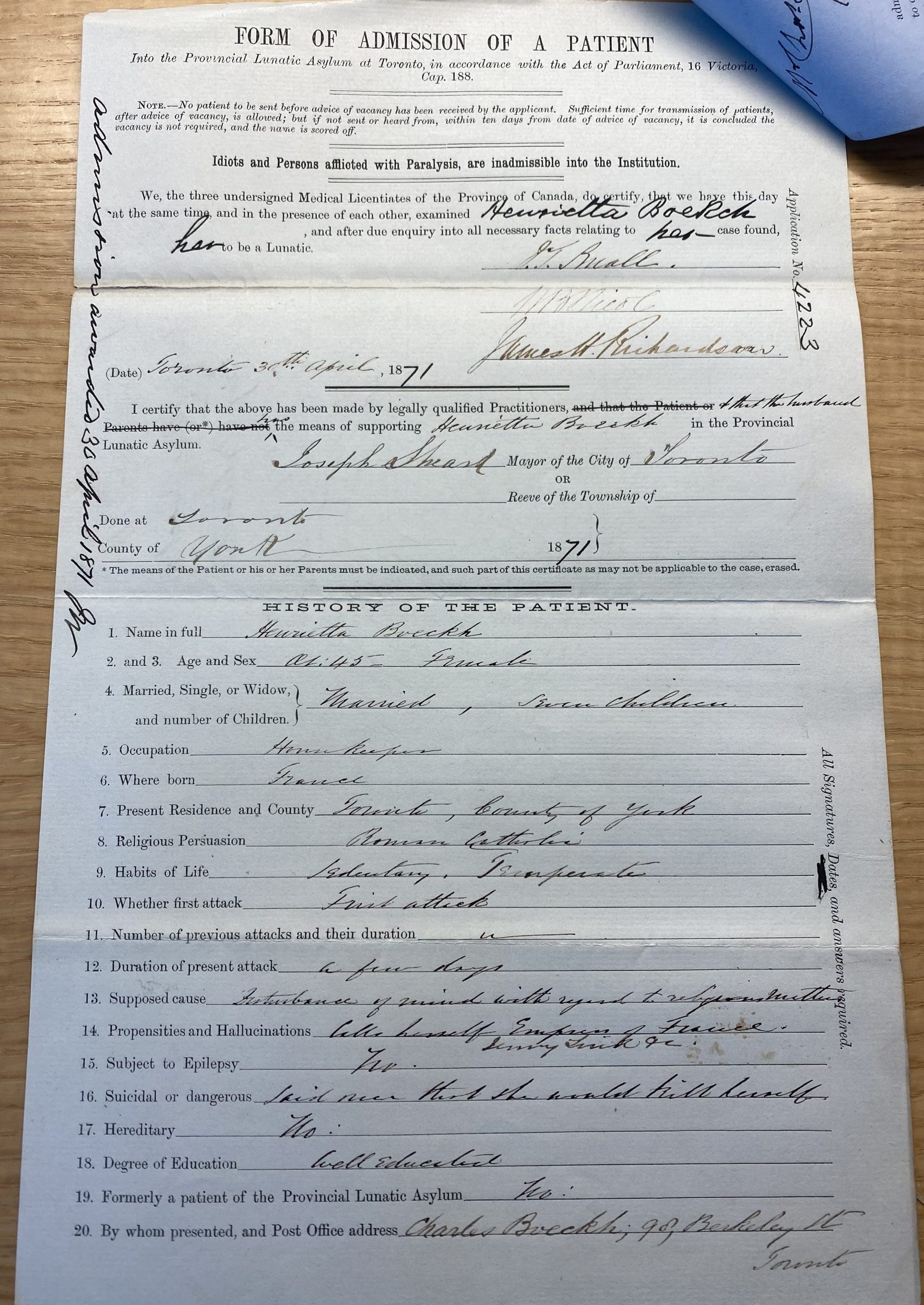
The immigrant patient stories analyzed indicate the processes of socioeconomic class, cultural identity, and institutionalization are connected. Upper-class immigrant patients were able to pay for confinement, which made their experience preferable to that of pauper patients. Margaret Griffin, 49, born in France, was admitted to the asylum in 1893, for the third time. She was a well-educated widow with access to trust fund income and paid $6 a week for her own confinement. Her story of confinement is multigenerational as her father, Lancelot Davidson, was also admitted to the asylum in 1863. Although she claimed not to take spirits, the asylum staff bought her brandy, underscoring the complex relationship between wealth and cultural behaviour. Henrietta Boeckh from Strasbourg, France was received as a patient on several occasions, suggesting a recurrent struggle with mental health which her financial resources allowed her to address. The mother of seven children, she called herself the “Empress of France,” demonstrating that some mental illness was also linked to cultural background. This case raises the meaning of the national identity within the context of mental health.
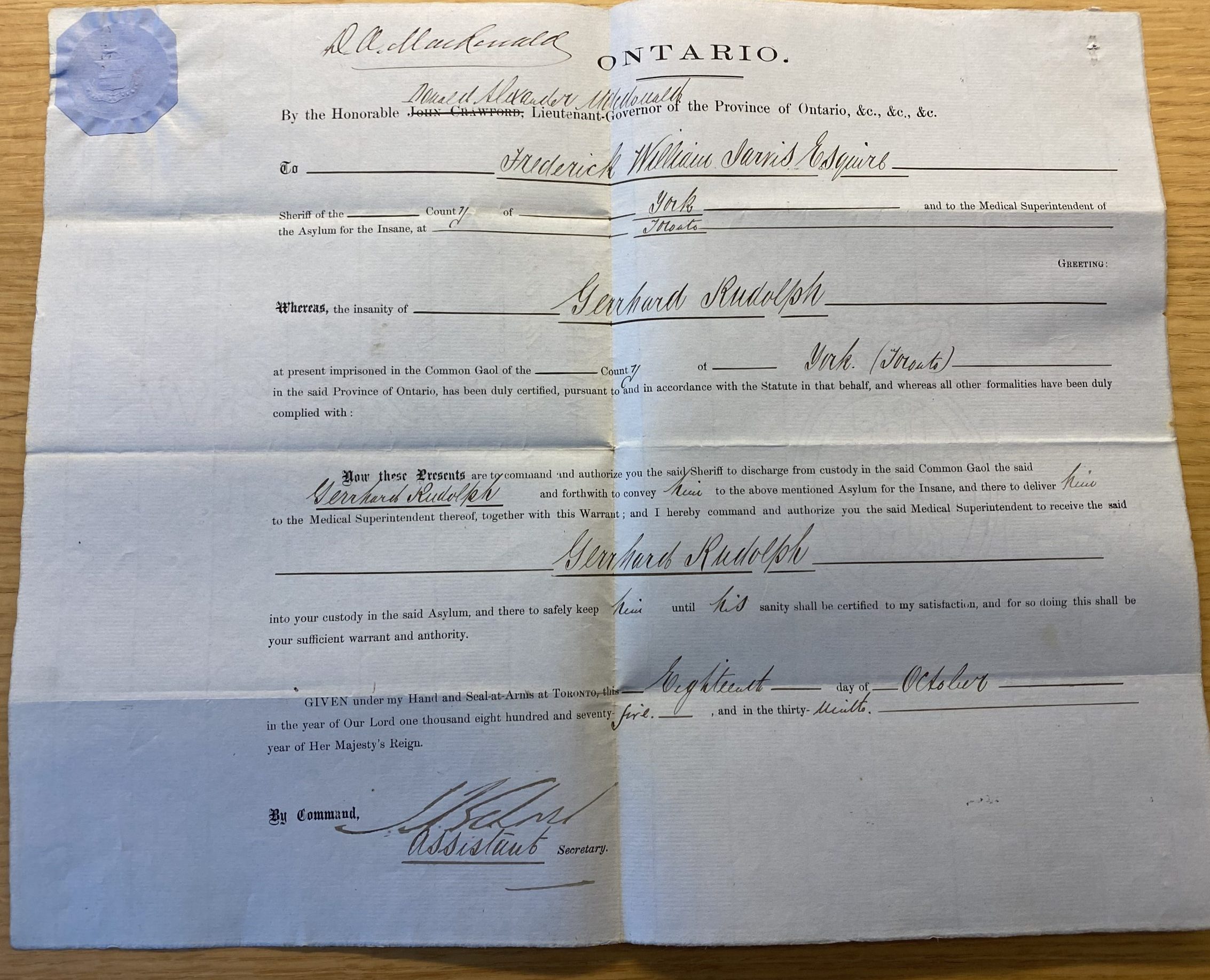
Other immigrant patients experienced intersecting forms of confinement when their path to the asylum intertwined with the criminal justice system. Many patients were committed to the asylum after having been incarcerated, revealing a trend from prison to asylum. Michael Vail, born in Mexico, and Peter McDiarmid, a widower who was born on a ship, were both received into the asylum from jail. University-educated Rudolph Gerhardt, a chemist from Saxony, Germany, with property in Chicago, spent time in prison for disruptive behaviour exhibited after a head injury, before being confined in the asylum. His case shows that even privileged people could be criminalized and institutionalized as the result of mental health issues.
Generally, those who came alone to Canada and were admitted to the asylum had some degree of financial security. Abraham Alexander, a German-Jewish immigrant, who came to Canada on his own and worked as a peddler, had to depend on the asylum bursar to arrange for his father to send money from Germany. This is contrasted to the situation of those who came to Canada with their families, like law student John G. Manley from Jamaica, who had ample financial support from his well-connected family. However, Manley, the son of a reverend, was confined at 23 and left in the asylum for 24 years until his death even though his family was close by in Deer Park, Toronto.
My research shows that geography, social class, and family support were critical in shaping the processes of institutionalization of immigrant patients in the Asylum for the Insane, Toronto during the late nineteenth century. The quantitative data shows that the patients came from different countries, with the majority being German, while the qualitative case studies demonstrate that the relationship between wealth, cultural identity, and institutional power is complex. I will conduct further analysis of this extensive number of documents to examine in more detail how these processes concurrently affected these patients and make further suggestions about the role of gender, age, and generation.